When Yesterday’s Pain Becomes Tomorrow’s Fear
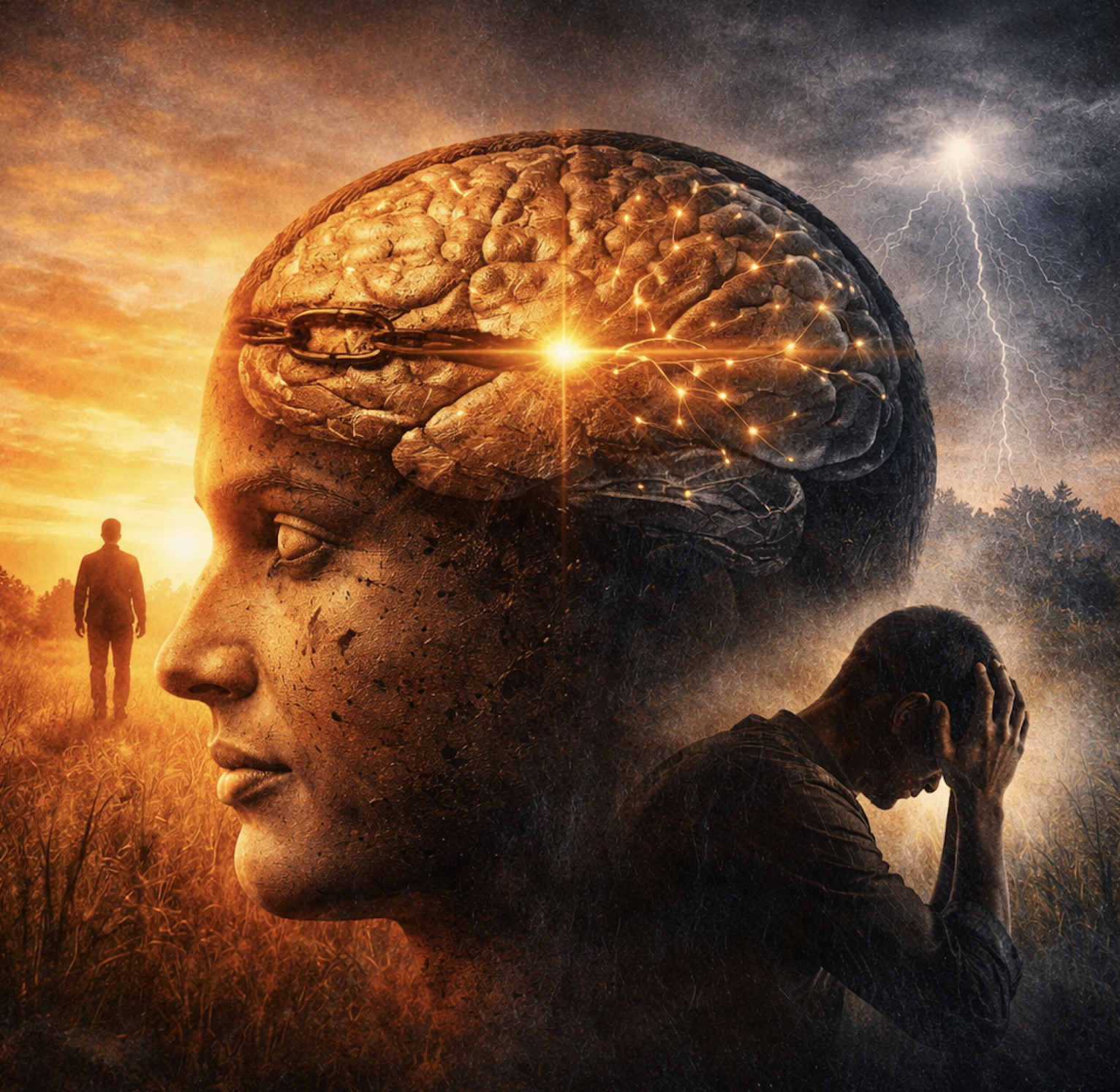
Peter Crone, who has gained tremendous notoriety in the last few years as “The Mind Architect,” has a quote that captures a profound truth about the human experience: “Past hurt informs future fear.” In just a few words, it points to one of the deepest roots of our suffering.
Much of what we fear is not truly about the future. It is about unresolved pain from the past that has not been fully understood, processed, or released. It’s energy remains stuck in the body, and like a thorn in our side, the slightest trigger, creates apprehension that is very familiar to us.
The brain is wired for survival. Its primary role is to predict and protect us, and one of the ways it does this is by carefully cataloguing painful experiences. Rejection, betrayal, humiliation, abandonment, failure, heartbreak, loss—these moments are not simply discarded. They are stored, tagged, and shelved within the nervous system so the mind can recognize similar signals later through association.
This is part of the brain’s evolutionary design and protective intelligence.
If something hurt us once, the mind wants to make sure we do not step blindly into that same pain again. We only have to touch a hot stove top once, and we learn to exercise caution in the future. So when a familiar tone of voice, a relationship dynamic, our partner’s facial expression, circumstance, or emotional environment appears, the brain quickly scans it’s hard drive and searches its files. If it detects something/anything that resembles a past experience that was particularly painful, it sounds the alarm.
It warns us.
A biochemical cascade directs our physiology to “be on guard, be alert.” We all know this cascade of events.
It tightens the muscles in the body.
It stirs anxiety within us.
It creates hesitation and apprehension.
The sympathetic nervous system (our “fight” or “flight” impulse) is activated.
It urges us to withdraw. We the narrowing of the lens of awareness we enter an acute state of very heightened awareness. We become defensive, attempt to control, or pursue avoidance. Anything to circumvent our fear that’s now taken over. The enemy within.
In this way, fear is often not a response to what is happening now, but to what the mind believes might happen because something similar happened before. This present event/circumstance has all the hallmarks of something that occurred in childhood that made us feel powerless. The brain remembers even though we may not.
What we call fear is more than not, memory (our past painful experiences) projected forward into the present moment, with us anticipating something catastrophically ruining our future.
The present moment becomes filtered through the lens of unresolved pain/trauma from our past. We are no longer consciously responding to life as it is, but unconsciously reacting to life as it reminds us of what once hurt us.
A person who was betrayed may fear intimacy and the vulnerability of connecting with others.
A person who was criticized may fear visibility or being the center of attention.
A person who was or felt abandoned may brace for loss and sabotage a healthy relationship even while being loved deeply by another.
A person who has failed may fear trying again, yielding to limiting beliefs and a self-deprecating internal dialogue that tells us, “it can’t be done.”
The fear feels real because, to the brain, the resemblance of our current circumstance to a past event is enough. The mind sees a recognized pattern, associates it with prior pain, or perhaps an emotionally traumatic experience, and moves into protection mode. It does not distinguish between an actual present threat and an old emotional imprint being reactivated.
And while this mechanism is understandable—even brilliant in its intent and design—it can also become a primal prison.
As a result we develop survival identities, usually formed early in life. They are not objective truth; they are interpretations the mind adopted to protect itself.
They’re built from beliefs such as:
I’m not enough — the root feeling of deficiency; not good enough, smart enough, attractive enough, successful enough.
I’m not worthy / deserving — the belief that love, success, health, or ease must be earned.
I’m not safe — a chronic sense that life is threatening, so control and hypervigilance feel necessary.
I’m not loved / lovable — the fear that one’s real self will not be loved.
I don’t belong / I’m rejected — the sense of being outside the tribe, disconnected, unseen, or excluded.
I’m not important / I don’t matter — the belief that one’s presence, needs, or voice carry little value.
I’m powerless — the feeling that life is happening to you and you lack agency.
I can’t trust life / uncertainty — the compulsion to predict, manage, and control because the unknown feels dangerous.
I have to perform to be accepted — identity gets built around proving, achieving, pleasing, or getting it right.
Something is wrong with me — the global shame-based identity underneath many addictions, defenses, and perfectionistic patterns.
With these beliefs, the very system designed to protect us can begin to limit us. We stop trusting. We stop opening. We stop risking. We stop living an authentic life and begin editing our personality to please others. We stop allowing life to flow through us, because the past has conditioned us to anticipate pain before it arrives. We stop seeing life as something happening “FOR” us, and something happening “TO” us, imposing its will on us, and feel defenseless in its assault.
This is one of the great unseen causes of suffering: we relate to the present through the lens of old, unhealed wounds.
Healing begins when we recognize the pattern.
The moment we see that our fear may not be a prophecy, but a protective response shaped by memory projecting itself onto our current circumstance, space begins to open. Space to pause. Space to question the internal narrative/story playing out in our head. Space to discern whether this moment is truly unsafe, or simply familiar to a pain we have not yet processed and resolved.
This does not mean the past did not matter. It does. Nor does it mean the brain is wrong for trying to protect us. It simply means that what once served as protection may now be distorting perception.
The work, then, is not to fight the mind, but to understand it and let go. Give up resisting and enter into what Zen Buddhist call, flow.
This is when we notice when an old wound is being stirred.
We observe when fear is arising from association rather than reality. We then, gently bring awareness to the difference between what is and what was.
Because once we see clearly that yesterday’s pain is shaping today’s fear, we begin loosening its grip.
The past may explain our fear, but it does not have to govern our future.
And perhaps that is where freedom begins:
when we stop living as though every new moment is responsible for what an old moment once did to us.